Sunday, April 18, 2010

Trip 10: Milwaukee Avenue District


Date: April 15, 2010
Trip: 10
No. of Landmarks Visited: 1
Landmarks To-Date: 13
Landmarks Remaining: 340

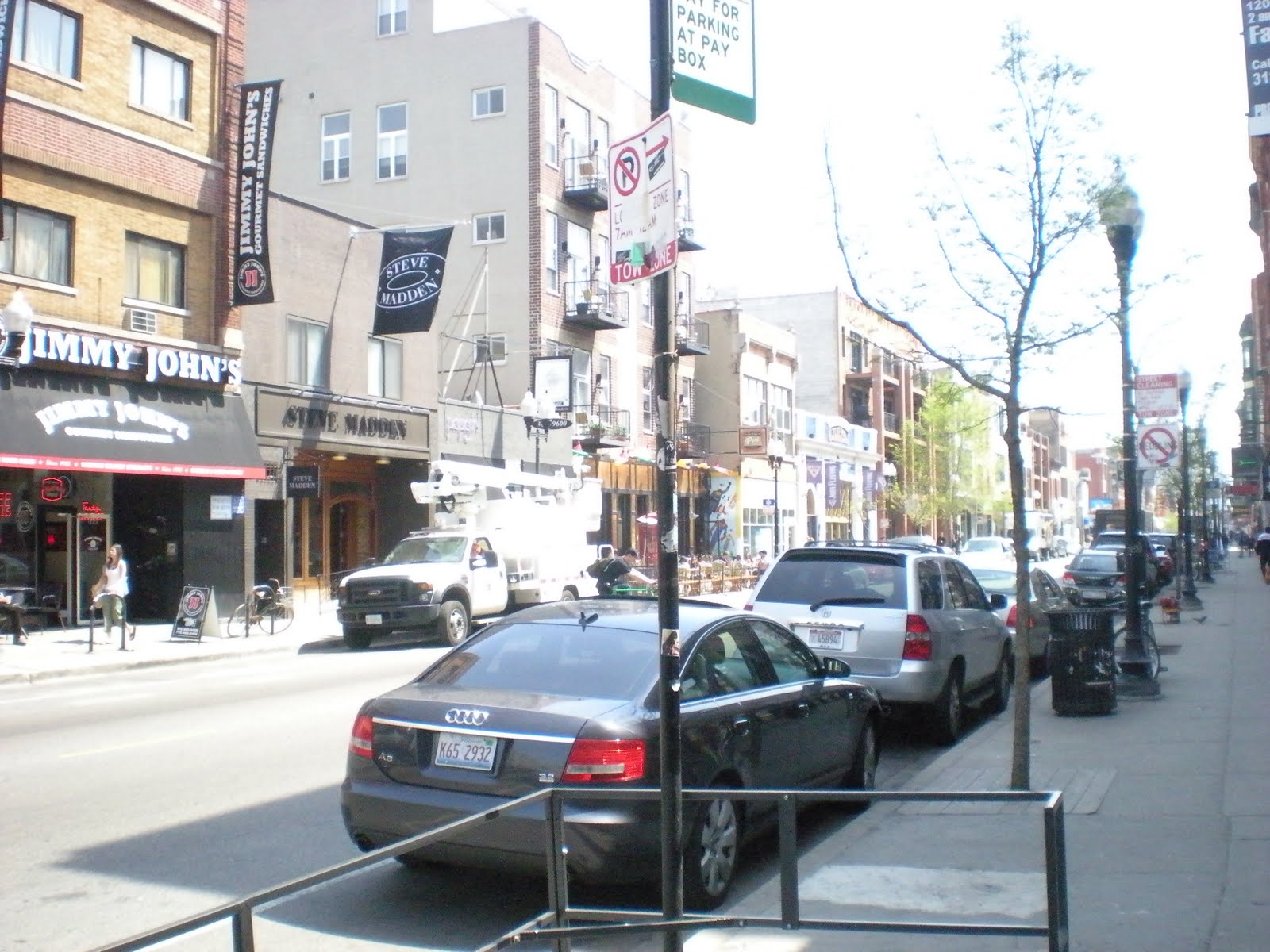
On Thursday I used my lunch break to walk to the Milwaukee Avenue District, which I think most Chicagoans consider to be the heart of the Wicker Park neighborhood. The historic district includes the intersection of Milwaukee, North and Damen. Milwaukee runs diagonally to Chicago's street grid and is primarily commercial in most places. Because of the night clubs, shops and restaurants in the area, Wicker Park is probably the most popular neighborhood for people from other parts of Chicago to visit. I've been to the area many times myself, and have taken a number of out-of-town guests there as well.

Milwaukee is primarily lined with 3 to 4 story brick buildings from the 1800's. Some of the buildings still have the original iron facades for the first floor storefront. But most of the street level facades have been renovated over the years for different business uses. But I would say a majority of the buildings still have their original facades on the upper floors.

Tuesday, April 13, 2010

Trip 9: Holy Trinity Orthodox Cathedral and Rectory


Date: April 13, 2010
Trip: 9
No. of Landmarks Visited: 1
Landmarks To-Date: 12
Landmarks Remaining: 341

Today on my lunch hour I walked to see Holy Trinity Church. It's a copy of a traditional Russian Orthodox church in Chicago's Wicker Park neighborhood. It's not a huge building, but it has (sort-of) an onion dome like you see in post cards from Russia.

The biggest surprise for me was that a plague says the building was designed by Louis Sullivan. It doesn't look anything like what I think of as a Sullivan building. But then I guess he had to design what the client wanted.

The building could use a little maintenance, but it's still adds some architectural variety to the neighborhood.


Trip 8: Chicago Public Library/Cultural Center


Date: April 10, 2010
Trip: 8
No. of Landmarks Visited: 1
Landmarks To-Date: 11
Landmarks Remaining: 342

I kind of cheated with the Cultural Center because I had to be there last Saturday for the Chicago Creative Expo. The expo is basically a one day convention of businesses and organizations that target the arts. I had a table there for my insurance business

The Cultural Center was originally built as a Chicago public library branch. It's a Romanesque temple-style building with two huge marble staircases, a Tiffany dome and coffered ceilings. The interior lay-out is a little odd, in that it's difficult to get to one end of the building from the other.

I planned to take pictures of the exterior of the building after the expo, but I was a little tired at that point. And I had a lot to carry. So all I took were a couple of bad interior shots.

Trip 7: Newport Avenue District & Belmont-Sheffield Bank Building


I'm going to add a countdown to my blog. It will list the date of the trip, the number of the trip, the number of landmarks seen, and the number yet to go. Here's the current count:

Date: April 8, 2010
Trip: 7
No. of Landmarks Visited: 2
Landmarks To-Date: 10
Landmarks Remaining: 343

So last Thursday after work I walked from home to the Newport Avenue District. It's basically a one block area of traditional Chicago greystone homes. At least they fit my definition of a Chicago greystone; a two or three story brick home with a gray stone facade and some type of decorative cornice at the roof line. In a more middle class neighborhood like Lakeview (where Newport is located) the greystones are mainly three flats on a single lot. This is opposed to the ones I saw earlier in Wicker Park which were generally single family homes on double lots.

The higher-end greystones include stone porches with stone pillars, curved glass windows, some stained glass windows and stone cornices (as opposed to wood or metal). Some have smooth stone finishes (as opposed to most with rough-cut stones). I don't know if this relates to costs (the higher-end greystones do seem to have more smooth stone) or just that styles changed over time.

There's not a lot of stained glass or other high-end finishes on Newport--although a couple of greystones have granite porch pillars as opposed to the usual sandstone (I think) or wood. Still it's a beautiful tree-lined street.

Next I walked to Belmont Street to see the Belmont-Sheffield Trust & Savings Bank building. It's no longer a bank--in fact the first floor is a Walgreen's and the upper floors are probably condos. It's very large building for the neighborhood. The most interesting piece of the bank left is the night deposit door on the outside of the building. It appears to be bronze, so I'm surprised that it hasn't been stolen for scrap. I went inside the Walgreen's but unfortunately not much is left of the bank. I was hoping that the pharmacy counter would be behind old teller windows, but Walgreen's (or an earlier tenant) ripped that all out. There is what appears to be some of the original stone tile floor left, and what might have been a skylight or atrium at some point. Now it's back lighted with electric lights.

As an added bonus I got to see the public art at the Belmont L station on the way one. There are tile mosaics and one large steel sculpture. While not a landmark, I was pretty impressed with the new station.

Friday, April 2, 2010

Trip 6: Congress Theater


After a hiatus for vacation in Florida, I walked from my office on Tuesday to see the Congress Theater on Milwaukee. It's still in use as a live entertainment venue, but I've never been there.

I think there used to be a huge vertical 'Congress' sign as part of the marquee to the theater, but all that's there now is the framework. Hopefully, they're just restoring the sign, because I think it was one of the unique features of the Congress.


Thursday, March 18, 2010

Trip 5; Wicker Park District


Yesterday I walked to the historic district in Wicker Park. It's a neighborhood of impressive brick and stone homes (and mansions) from probably the turn of the last century. The homes are more urban than those on Hawthorne Place that I visited just a couple of days ago. To me Wicker Park is more representative of Chicago. I think of 2 or 3 story grey stones as typical of Chicago-style. Wicker Park has many of these.

I remember reading somewhere that Wicker Park was home to the original beer barons in Chicago. Beer apparently paid for a lot back in the day.

Chris


Wednesday, March 17, 2010

Trip 4; Hawthorne Place District


After work yesterday I walked from home with Shawn to the 500 block of Hawthorne Place. It's only a few blocks from our place in Lakeview. It's one of the few areas in the neighborhood with single-family homes. The houses on this block are also unusual for Chicago because they look more like country homes than city houses.


I've also heard a rumor that the actress Joan Cusak does or did live on Hawthorne. But that might just be an urban legend.

There is one ugly apartment building on the block that looks like it was built in the 1970's. And there is what is probably a very expensive private day school.